There has never been a better time to treat your fields to

The best value multinutrient fertiliser on the market and the preferred choice of Britain’s farmers. Fibrophos is a naturally produced, cost effective phosphate and potash fertiliser that is perfect for arable and grassland. It provides all your PK requirements and contains the full range of secondary and trace elements.

  • An ideal Phosphate and Potash fertiliser for use across the farm
  • Perfect for grassland and arable alike
  • Phosphate releases throughout the growing season, optimising crop growth
  • Contains Potash and Magnesium in balance so reduces the risk of grass staggers
  • Consistent, well-established and proven product
  • Entirely produced in the UK
  • Available in a range of grades to suit your soils
  • Applied by experienced contractors it gives you more time at busy periods
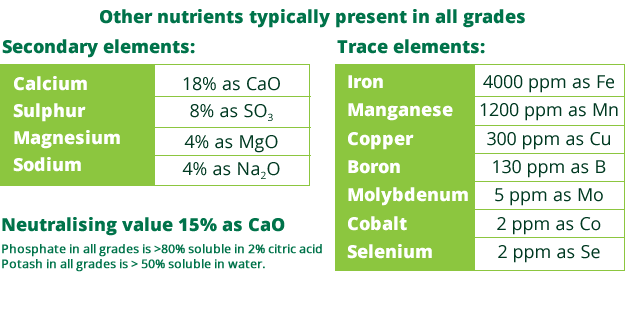
  • Contains valuable secondary elements - Magnesium, Sulphur, Calcium, Sodium
  • Contains a wide range of trace elements at no extra cost
  • Competitively priced
  • Environmentally friendly and derived from renewable sources
Back to Hatcher Fertilisers

What’s in Fibrophos and how does it work?
Fibrophos is a renewable, totally organic, concentrated PK fertiliser consisting of phosphate, potash, sulphur, magnesium, calcium, sodium and significant quantities of essential trace elements required by crops and grass to achieve high yields.

It’s not a blend. It’s a unique modern fertiliser that replaces nutrients in the same ratio removed by the growing crop. The immediate effects are a big PK boost and increased yields. The longer term benefit is that it will release those nutrients steadily over time, building balanced, stable soil and healthier, stronger crops.br>
It comes from the manure from cereal fed chickens, which is incinerated at high temperature to produce pure fertiliser containing all the plant nutrients (except nitrogen) which were present in the poultry feed.

For two decades farmers have seen the benefits of Fibrophos and demand grows year on year. Research has confirmed that the phosphate and potash in Fibrophos are as effective as Triple-Superphosphate and Muriate of Potash and that secondary and trace elements offer an additional bonus. It works and it works very well.

Phosphate
Extensive trials have shown that Fibrophos® is a very effective source of phosphate across a wide range of agricultural soil types throughout the UK.

The phosphate in Fibrophos® is more than 80% soluble in 2% citric acid and nearly half is soluble in neutral ammonium citrate providing a long lasting as well as immediate supply to the growing crop.

Trials showed that application of Fibrophos® to both acid and alkaline grassland or arable crops significantly increased available soil phosphate within one month and this increase was maintained for at least 12 months.

As a long lasting source therefore, Fibrophos® is ideal for raising the soil phosphate status and maintaining it. Used for this purpose when soil phosphate is 0 or 1, Fibrophos® can be applied at 625kg/ha (5-6 cwt/acre) every two to three years depending on crop potential. This will provide an adequate level of phosphate to ensure full effectiveness of nitrogen or compound fertilisers.

Phosphate is not prone to leaching, so can be applied at any time of year.
Phosphate is essential for plant growth development.
Citric soluble phosphate helps build up soil fertility over time.
Low phosphate levels across the UK are limiting yields of grass and clover leys.
Phosphate raises the mineral content of grass and improves the root system.
Silage removes up to 2kg of phosphate per tonne of 20% DM silage.

Potash
Potash is an important nutrient for grass, especially where the whole crop is removed by silage and hay cuts.
It is essential for grass yield. The potash removed in a crop is in proportion to the yield, e.g. 27 units/acre of potash are removed in each tonne of grain and straw; 40 units/acre of potash are removed in each tonne of hay. Fibrophos® not only replaces the potash removed but also replenishes the soil with important secondary elements and most of the trace elements vital to crop growth and the well being of grazing animals. As the potash in Fibrophos® is less soluble than inorganic fertilisers (50 per cent water soluble), the uptake of potash is less rapid, avoiding luxury uptake that can cause staggers.

ADAS trials carried out by ETSU for the DTI confirmed that the potash is very quickly available and is as effective as muriate of potash. Any potash remaining will become available to the plants in the longer term, making Fibrophos® a very effective fertiliser for grass and arable situations. Because the potash is available in line with crop growth demands, plants become healthier and stronger. Since these early trials conducted in 1994 over 500,000t of Fibrophos® has been sold nationwide for both cereal and grassland applications. Many of the sales made today are to farmers who have used Fibrophos® across their farms for the past 12 years - thus endorsing the work carried out by ADAS.

Potash index should be 2 for adequate growth
If indices are under 2, then larger amounts of potash should be applied to replace and improve index over a period of years.
Grass yield increases of 65% have been shown on soil K index 0. (28% on soil index 1).
Light land requires more potash than heavy land. Low potash reduces grain yield, quality and vigour.
Potash in potatoes is the most important nutrient affecting quality, tuber size, dry matter, storage and drought and disease resistance.
Setaside crops will remove some potash which can be a problem on low K soils.

Sulphur, Sodium & Magnesium
Fibrophos has levels of sulphur that will reduce the risk of soil deficiency and contribute to higher crop yields. Sodium will improve the palatability of grass an help maintain healthy pastures, trials have proven that Fibrophos has a greater uptake of magnesium than TSP and MOP and regular application will increase soil PH and decrease costs.

Secondary and Trace Elements
In addition to the major and secondary nutrients, Fibrophos® contains a full range of trace elements.We now know that these trace elements are essential nutrients for all growing crops and need replacing. Fibrophos® puts back trace elements in the same proportion that they were initially removed - because it is produced from combusted (cereal-rich) poultry manure.

Manganese
Adequate levels of Manganese are required to improve the enzymic reactions in crops. Deficiencies are common on organic and sandy soils at high pH. The high levels of Manganese in Fibrophos® can reduce the risk of crop deficiency in these situations.

Boron
Boron is known to improve sugar synthesis and regular applications maintain a better soil balance particularly for root crops and oilseed rape.

Copper
Copper deficiencies occur in some regions, particularly on cereals on sand, peat and shallow organic soils over chalks. Deficiencies are often expensive to rectify. All trace elements in Fibrophos® are supplied at no extra charge sp provide a cost effective way to give peace of mind.

Cobalt
Cobalt is required by Rhizobium - the symbiotic bacterium that fixes nitrogen in the root nodules of clovers and legumes. Cobalt is also essential for animals in forming vitamin B12. A lack of cobalt causes 'pining' in sheep and stops clover fixing nitrogen.

Molybdenum
Molybdenum is essential for clover to fix nitrogen. Associated with acid conditions, deficiencies can lead to poorer use of nitrogen, so Fibrophos® will help eliminate such a risk.

Zinc
Zinc is essential for both animals and plants. Deficiencies occur on sandy soils with high pH and phosphate levels and has been known to be a problem in maize.

Iron
Iron is taken up by the plant roots and is involved in enzymic reactions and the formation of chlorophyll. Although deficiencies are not common, chlorosis in sugar beet and some cereals can be a problem. Fibrophos® helps maintain the balance.

Environment
Fibrophos is naturally produced and is derived from totally natural and organic origins, using renewable sources of chicken litter and wood waste such as bark and chippings. It’s use as a fertiliser replaces mined phosphates and potash which are costly on the environment to mine and import. Poultry manure cannot be applied during the wet winter months due to problems with nitrogen leaching - the manufacture of Fibrophos takes poultry manure throughout the year thus avoiding leaching issues.

Grassland
Fibrophos® is unique as an all-in-one concentrated fertiliser. It not only raises the soil phosphate and potash status, but it also contains a complete range of secondary and trace elements including calcium which provides an excellent lime value for the soil.
The generally low phosphate and potash indices that have been recorded on grassland across the UK and more recent reports on soil sulphur deficiencies have lead to greater awareness of the potential shortages for crops. New silage analysis techniques will show the contribution of forage to the ration and the feeding value of home-grown conserved feed.

But yields from grass leys and quality silage for winter feeding can only be maximised if soil fertility is at it's optimum.

The aim with soil fertility is to build up a satisfactory stable and balanced level of nutrients capable of sustaining high yielding grasses and to enable efficient use of available nitrogen - which also helps reduce nitrogen leaching.

Fibrophos® has been used extensively on British grassland for a number of years with impressive results.

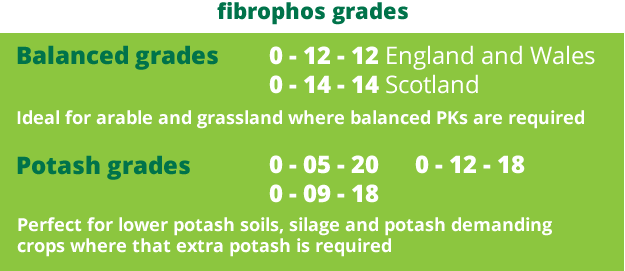
Two grades of Fibrophos® are particularly well suited to silage making - Fibrophos High K 0-9-18 and Fibrophos Balanced 0-12-12.

On grassland, a good supply of phosphate is essential to support clover, so Fibrophos® is ideally suited for regular applications to grass/clover mixtures, whether sown or permanent. Fibrophos® Traditional 0-24-06 can be used for grazing when soil phosphate levels are lower, either every year or every three years.

The problem of soil nutrient deficiency is naturally compounded after cuts of silage and hay, so it is vital to apply fertiliser well in advance of cutting. 

Arable
Fibrophos® is ideal for cereals, oilseed rape, peas, beans, linseed and many other arable crops. Effective across a wide range of soil pH conditions, Fibrophos® supplies not just phosphate and potash but the secondary elements of sulphur, magnesium, calcium and a wide range of trace elements. Replacing the nutrients removed and maintaining soil fertility are the key issues for arable farming today and Fibrophos® does just that. The nutrient balance of Fibrophos® is very similar to that removed by cereal crops which is to be expected from a recycled fertiliser derived from poultry with a cereal diet.

ADAS trials carried out by ETSU for the DTI confirmed that Fibrophos® performs equally as well as TSP within the first growing season after application. Any phosphate remaining will become available to plants in the longer term, making Fibrophos® a very effective fertiliser for enhancing long term fertility.

The ADAS report recommended annual applications of Fibrophos® or larger dressings at two to three year intervals for nutrient maintenance purposes. Maintaining a satisfactory, stable and balanced level of nutrients capable of sustaining high yielding crops also enables efficient use of available nitrogen. Fibrophos®' ability to release it's nutrients for up to three years, enables the farmer to apply sufficient nutrient in one year and then forget about his phosphate for another two years - only topping up with nitrogen and potash as required.

Spreading & Application Rates
Fibrophos® is a coarse powder and therefore should be spread using a contractor with the appropriate experience and equipment for spreading this type of material. It is recommended to employ a trailed spreader with a moving belt floor system or similar, such as those found on Atkinson, Bredal, Land Drive or Transpread machines.
It is the responsibility of the user to read and understand the Material Safety Data Sheet, to ensure that the product is fit for purpose, and to apply the product in accordance with the DEFRA Code of Good Agricultural Practice.
Farmed animals must not be allowed access to the land for at least 21 days following application to land.


© John Hatcher & Co Ltd 2009